




How To Do Savasana: Benefits, Steps & More
Table of Contents
- What Is Savasana? Why Is It Called Corpse Pose?
- Is Savasana The Hardest Pose In Yoga?
- 9 Savasana Benefits: Why Should You Practise The Corpse Pose?
- How To Do Savasana (Corpse Pose)?
- Modifications to Use When Lying Flat Do Not Work
- Why Practising Savasana Goes Beyond Yoga?
- 1. Savasana Works After Any Workout, Not Just Yoga
- 2. Savasana Reduces Vata Imbalance in Ayurvedic Terms
- 3. Savasana is Different From Yoga Nidra
- Difference Between Conscious Stillness (Savasana) & Sleep
- Best Preparatory Poses to Maximise Corpse Pose Benefits
- Moving forward
- Frequently Asked Questions
- Savasana or Shavasana, what is the correct pronunciation?
- How long should I hold Savasana?
- Is it okay if I fall asleep while practising Savasana?
- Can I do Savasana without a full yoga practice?
- Is Savasana the same as Yoga Nidra?
- Why do some people feel anxious lying on their back in Savasana?
- Is there a specific way to breathe during Savasana?
You’ve spent sixty minutes sweating and performing multiple asanas. Your heart is pumping, and your muscles are warm. Then comes the instruction every yogi waits for (and some secretly avoid): “Slowly make your way onto your back for Savasana.”
Savasana is an intentional, conscious act of letting go. The one that happens to carry more physiological and psychological weight than almost every other yoga pose in the practice. Here, we cover what Savasana is, why it’s harder than it looks, what it does to your body and mind, and why skipping it isn’t the smart shortcut most people think it is.
What Is Savasana? Why Is It Called Corpse Pose?
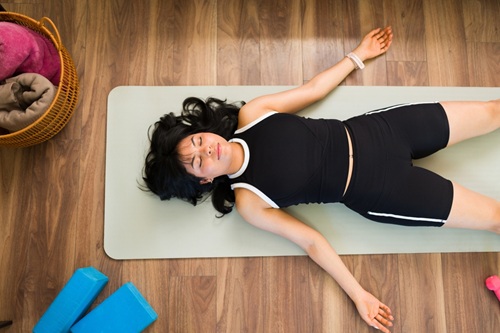
Savasana, or Corpse Pose, is a yoga pose done at the end of the session in the supine position (lying down) to calm the nervous system. It is a deeply relaxing and restorative asana that involves slow and purposeful stillness of mind.
Savasana (pronounced sha-VAH-suh-nah) comes from two Sanskrit words: ‘Shava‘, meaning corpse, and ‘Asana‘, meaning pose or seat. In English, it is called the Corpse Pose. Some texts also refer to it as ‘Mritasana‘, from the Sanskrit word mrita, which means ‘death‘.
The word ‘corpse’ is not meant to be dark. In yogic philosophy, death is not an ultimatum or an ending. It is a return to the state before life begins. In each yoga routine, yogis work through active, effortful postures and then dissolve into rest. Savasana is the same dissolution. It is the moment when everything you developed in your session finally finds its place.
There is also a question of spelling. Savasana and Shavasana are the same pose. The “sh” in Shavasana reflects the Sanskrit pronunciation more accurately. Both are widely used, and both are correct.
Is Savasana The Hardest Pose In Yoga?
Ask a beginner, and they’ll say handstand is the hardest. Ask a master, and they’ll say it’s Savasana. Not because of anything physical; the part that struggles most in the Savasana pose is the mind.
Why? Because in our modern world of constant notifications and hustle culture, we have forgotten how to be still without being asleep. Most of us are addicted to doing it. When we lie down in the Savasana pose, the “monkey mind” starts to scream. The difficulty arises not in the muscles but in the nervous system.
While every other yoga pose gives the brain a job to hold an alignment, track balance, or breathe through a stretch. In Savasana, there is no task, no correction, no effort to make. And the brain, which is conditioned to always process something, finds that genuinely hard and uncomfortable.
Neuroscience suggests that when the mind has no external task, the default mode network activates. That is the brain’s internal chatter disguised as thoughts and visuals. In Savasana, you are supposed to let that picture vanish, and the chatter be quiet. This is the task that makes the Corpse Pose the hardest yoga pose.
9 Savasana Benefits: Why Should You Practise The Corpse Pose?
While it may feel like a break, your body is undergoing intensive maintenance and reformation during the 10 minutes you practise Savasana. The benefits of the Corpse Pose are not just theoretical. Each one has a physiological or psychological basis. Here is what happens when you lie in Savasana:
- Just like sleep, it gives your body the calm state it needs to heal and repair itself from the inside.
- It lowers cortisol, the stress hormone your body releases when you are tense or anxious.
- Skipping this pose after yoga is like closing a file without saving it — it gives your muscles, blood flow, and nervous system time to actually absorb everything from your practice.
- Lying still and paying attention to your body builds awareness that slowly carries over into your everyday life, not just on the mat.
- Practising it regularly trains your nervous system to relax more easily, so you fall asleep faster and wake up less during the night.
- Moving your attention slowly through each part of the body and letting go of tension is one of the simplest ways it calms anxiety and stress.
- After a proper practice, your mind feels noticeably clearer, and all the noise and random thoughts from before tend to settle down.
- Within a few minutes of lying still, your heart rate slows, your breathing softens, and your blood pressure drops as your body shifts from stress mode into rest mode.
- Learning to stop controlling everything and just be still is a skill that helps you handle stressful moments in real life too, not just in class.
If you want to realise Savasana benefits at a depth that most modern classes do not reach, traditional yoga environments offer time, guidance, and silence that allow the pose to actually work. At Samadhi Yoga Ashram in Rishikesh, we treat Savasana as a complete practice in its own right, encouraging students to stay for the last ten minutes, where the magic happens. This deeper understanding of yoga practices is also an important part of a 200 hour yoga teacher training in Rishikesh, where students study asanas, breathing, meditation, and the principles behind a complete yoga practice.
How To Do Savasana (Corpse Pose)?
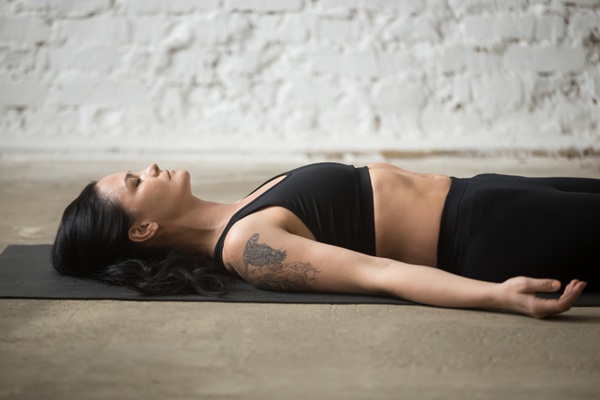
Savasana yoga has no alignment cues in the traditional sense. But how you set it up initially determines how well it will work for you.
Steps to do Savasana (Corpse Pose):
- Lie flat on your back on the mat. If the floor is cold or hard, place a thin blanket underneath you.
- Let your feet fall open naturally; there is no need to hold them together.
- Move your arms slightly away from your body, palms facing up. It allows the shoulders to drop back rather than rounding forward.
- Close your eyes; if closing your eyes feels uncomfortable or creates anxiety, keep a soft, downward gaze.
- Take three deep breaths to settle in. Then let the breath return to its natural rhythm.
- Systematically release tension; start at the feet and move upward. Most people carry tension in the face without realising it.
- After relaxing each part of your body, simply rest. If thoughts come, notice them and let them pass.
- Stay for a minimum of 5 minutes; traditional practice recommends 15–30 minutes.
- To exit: deepen the breath, gently move the fingers and toes, roll to your right side, and pause there before pressing up to be seated. Do not sit up suddenly, as it spikes the heart rate and undoes the calm.
Modifications to Use When Lying Flat Do Not Work
- Bolster Under the Knees: Helps relieve lower back pressure; useful for chronic lumbar pain
- Side-Lying Savasana: Ideal in case of pregnancy, acid reflux, or those for whom lying face-up triggers anxiety
- Blanket Under the Head: For neck stiffness or discomfort when looking straight up
- Eye Pillow: A gentle weight over the eyes can help the body relax and feel calm
Why Practising Savasana Goes Beyond Yoga?
The internal and external effects of the Savasana pose are not yoga-specific; they are biological. Beyond what we covered in the benefits section, here are a few specific reasons. Savasana extends beyond yogic practice and lying down, which deserve their own space:
1. Savasana Works After Any Workout, Not Just Yoga
Savasana is not only for the end of a yoga class. It works just as well after running, strength training, or any workout that leaves your body worked up. Exercise puts stress on the body, no matter what kind it is, and a few minutes of complete rest afterwards helps your body absorb the full benefit of what you just did. It also gives your heart rate, breathing, and nervous system time to settle back down before you rush into your next task. Even though most gym-goers skip this step, taking just five minutes to lie still and breathe after any workout can make a real difference.
2. Savasana Reduces Vata Imbalance in Ayurvedic Terms
In Ayurveda, Vata Dosha governs movement, air, and the nervous system. An excess of vata manifests itself as anxiety, poor sleep, restlessness, and dry skin, which increasingly becomes common in people who stay busy, scattered, or chronically stressed. Stillness, warmth, and grounding are the primary antidotes for vata, and Savasana provides all three.
3. Savasana is Different From Yoga Nidra
Savasana and Yoga Nidra are not the same thing. Savasana is a yoga pose in a supine (resting) posture done in complete silence or with light guidance. Yoga Nidra is a structured guided meditation practice that uses the Savasana position but takes the mind through specific stages toward a hypnagogic state.
As one of our yoga teachers put it plainly: ordinary sleep refreshes, Yoga Nidra rewires, and Savasana integrates. Each shares a shape but serves different purposes.
Difference Between Conscious Stillness (Savasana) & Sleep
Most practitioners walk a fine line between being fully conscious and falling asleep. But Savasana is neither of these. It is wakeful rest, i.e., being aware but not grasping, running, or lost.
During Savasana, many people ask, “If I’m lying still, why can’t I just sleep?” The difference is consciousness. In sleep, you lose awareness. In the Savasana pose, you remain fully aware but disconnected from external distractions. This is a state known as Hypnagogia.
When you wake up from a nap, you might feel worn out; when you emerge from the Corpse yoga pose, you feel clear. The body gets many of the same restorative benefits as in sleep, but with the addition of being present.
Best Preparatory Poses to Maximise Corpse Pose Benefits
The Corpse Pose sits at the end of practice, but what comes before it determines how well the body settles into it. These six poses create the best conditions for a deep, effective Savasana.
| Pose | Why It Pairs With Savasana | Best For |
| Balasana (Child’s Pose) | Gently relaxes the back and helps the body slow down | Before Savasana or when you need extra rest |
| Paschimottanasana | Stretches the hamstrings and lower back and helps calm the body | Right before Savasana |
| Viparita Karani (Legs-Up-The-Wall) | Helps relax tired legs and prepares the body for stillness | When tired legs make it hard to relax |
| Setu Bandhasana (Bridge Pose) | Opens the chest and hips before resting flat | After backbend sequences |
| Supta Baddha Konasana | Gently opens the hips and encourages relaxation | When restlessness makes it hard to settle |
| Anulom Vilom (Alternate Nostril Breathing) | Helps calm the body and prepares the mind for rest | Before Savasana in a seated practice |
Viparita Karani(worth highlighting in particular)
Sometimes called the ‘legs-up-the-wall‘ pose, you sit sideways against a wall and swing your legs up, lying on your back with your legs resting vertically. It is deeply restorative, reduces swelling in the legs and feet, and creates a gentle inversion effect without any effort. For practitioners who find lying flat too stimulating to relax into, Viparita Karani is often a more accessible entry point into the same relaxed state.
Moving forward
We focus heavily on the Savasana yoga pose at Samadhi Yoga Ashram because we believe a yoga practice without a proper ending is like a book without a final chapter. The lesson Savasana keeps teaching us is a simple one: rest is not the reward for effort. It is part of the effort itself.
Most people come to yoga wanting to become stronger, more flexible, or calmer. Savasana, or the Corpse Pose, addresses all three. The practitioners who rush out before it, or treat it as optional, are skipping the part of the practice that helps bring everything together.
Frequently Asked Questions
Savasana or Shavasana, what is the correct pronunciation?
Both refer to the same pose. Shavasana reflects the Sanskrit pronunciation more accurately (Shava, meaning corpse), while Savasana is the more common English spelling. You will see both in books, classes, and online; neither is wrong.
How long should I hold Savasana?
A minimum of 5 minutes is the practical floor for Savasana benefits. Ten minutes allows a fuller relaxation response. Traditional Hatha practice suggests 15 to 30 minutes. Most modern classes offer 3 to 5 minutes, which is better than nothing, but not the full picture.
Is it okay if I fall asleep while practising Savasana?
Yes, and it happens to most people at some point. Falling asleep usually means the body needs rest. Do not use falling asleep as a reason to stop practising it. Over time, with consistent practice, the ability to stay at the edge of alertness without crossing into sleep develops naturally.
Can I do Savasana without a full yoga practice?
Absolutely. Savasana, as a standalone practice, i.e., 10 to 20 minutes of conscious lying still while relaxing each part of your body, is one of the most accessible and effective forms of intentional rest you can do. It does not require a yoga mat, a class, or prior practice.
Is Savasana the same as Yoga Nidra?
No, Savasana is a yoga pose. Yoga Nidra is a kind of structured guided meditation that uses the same posture but takes the brain through certain stages, including visualisation and intention-setting.
Why do some people feel anxious lying on their back in Savasana?
For some practitioners, lying face-up in stillness can trigger anxiety, vulnerability, or discomfort. This is more common than teachers typically acknowledge. If you’re one of these, you can practice side-lying Savasana with eyes slightly open or a bolster under the knees to reduce the same. The goal is a position where the nervous system genuinely feels safe enough to let go.
Is there a specific way to breathe during Savasana?
Not specifically. Just take a few deep breaths to settle in, then allow the breath to return to its natural rhythm. Trying to control the breath in Savasana is unhelpful. The pose asks you to stop controlling things, including your breath.
This article is for general information and is not medical advice. If you have a respiratory or heart condition, are pregnant, or are unsure whether these practices suit you, please speak to your doctor before beginning. Yoga poses and breathing exercises should be practiced with proper guidance from a qualified yoga teacher to help ensure safe and correct practice.