




How to Master Crow Pose (Bakasana): Easy Steps and Benefits
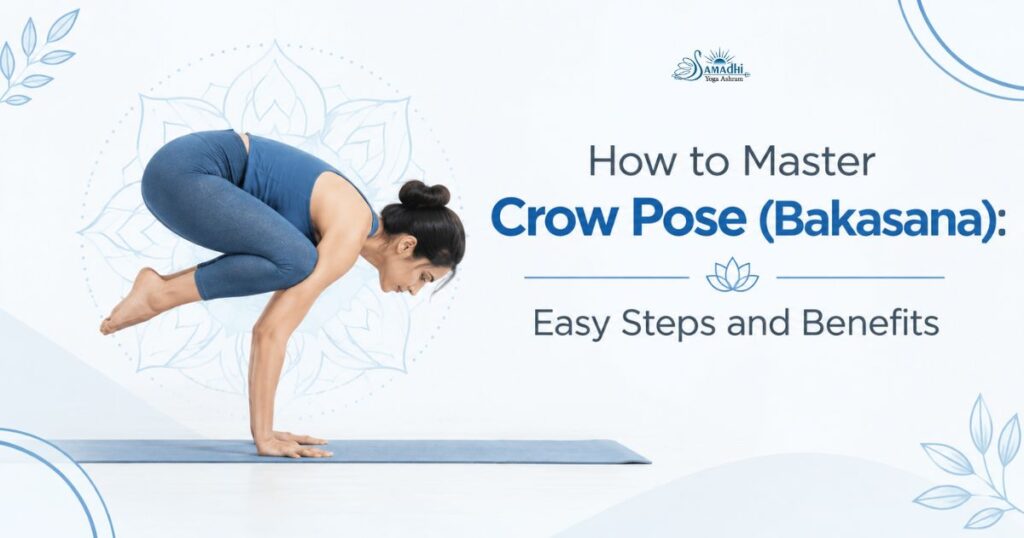
Table of Contents
- What Is Crow Pose (Bakasana)?
- Why You Should Try Crow Pose?
- How to Do Crow Pose?
- 1. Start in a Deep Squat
- 2. Place Your Hands Flat on the Mat
- 3. Bend Your Elbows to Make a Shelf
- 4. Rest Your Knees on Your Upper Arms
- 5. Look Forward and Shift Your Weight
- 6. Lift One Foot, Then the Other
- 7. Hold and Breathe
- 8. Come Out of the Pose Safely
- Can Anyone Do Crow Pose? What Should You Do Before You Begin?
- Warm-Up Recommendations
- Who Should Avoid Crow Pose?
- Key Takeaway
- Frequently Asked Questions
- How long does it take to learn Crow Pose?
- What should I focus on first when learning Crow Pose?
- Why do my wrists hurt in Crow Pose?
- Can Crow Pose help in other yoga poses?
- Why do I keep falling forward in Crow Pose?
If you have spent any time in a yoga class or scrolled through yoga content online, you have almost certainly seen someone balancing their entire body weight on just their two hands — knees resting on the backs of their arms, feet lifted off the ground, body hovering in mid-air with calm focus. That pose is Crow Pose, known in Sanskrit as Bakasana, and it is one of the most recognisable and rewarding poses in yoga. Whether you call it crow pose yoga or simply Bakasana, this pose has captured the attention of yogis worldwide.
For many Crow Pose represents a turning point a moment when yoga stops being just about stretching and becomes something far more powerful.
But here is the good news: Crow Pose is not just for advanced yogis. With the right technique, consistent practice, even complete beginners can work toward and achieve this pose.
In this comprehensive guide, we will walk you through everything you need to know about the benefits of Crow Pose, prerequisites, a detailed step-by-step tutorial, common mistakes and safety tips. By the end, you will have all the tools you need to lift off.
What Is Crow Pose (Bakasana)?
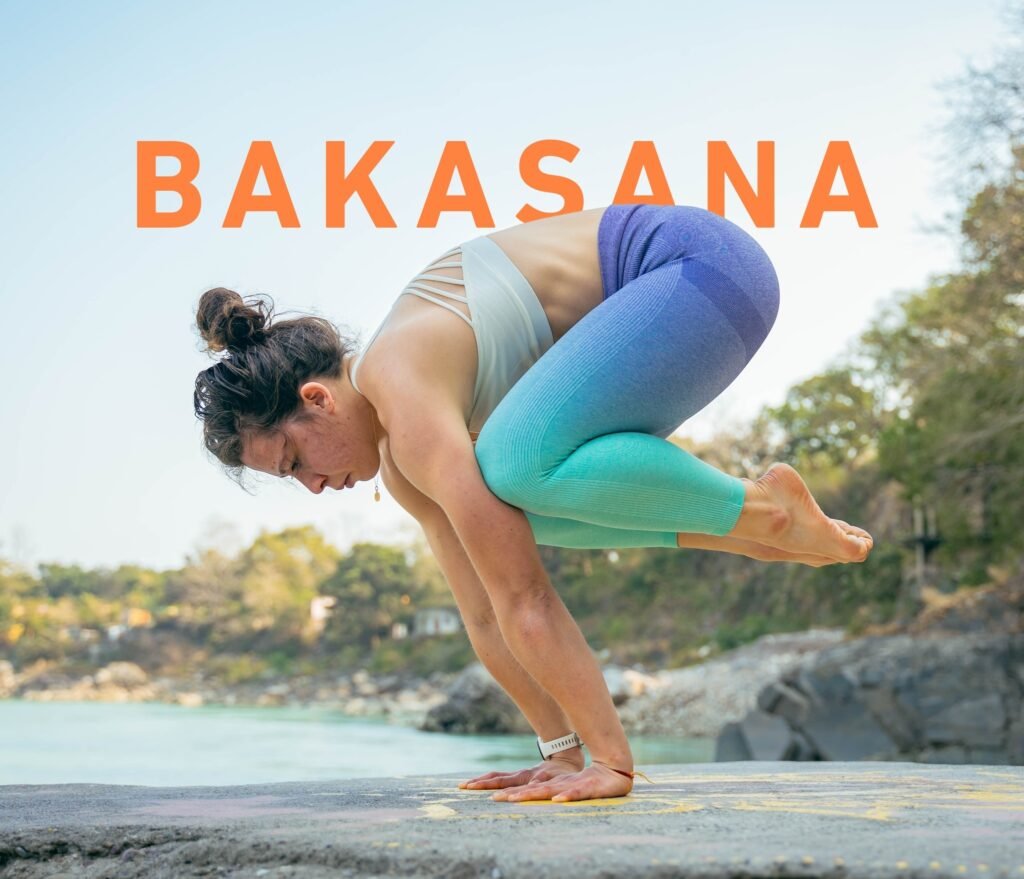
Bakasana comes from the Sanskrit words baka (crane or crow) and asana (pose). It is often interchangeably called Crow Pose and Crane Pose, though technically they are slightly different — in Crow Pose, the arms are bent, while in Crane Pose, the arms are fully straight. This crow yoga pose is unique in that it bridges flexibility and functional strength beautifully. For beginners, the bent-arm version (Crow) is far more accessible.
In this pose, you balance the weight of your entire body on your bent arms, with your knees pressing into the backs of your upper arms (triceps), your core engaged, and both feet lifted off the floor. It looks dramatic, but the mechanics are surprisingly learnable once you understand them.
Why You Should Try Crow Pose?
The crow pose is one of those yoga poses that looks intimidating at first, but rewards you in so many ways once you give it a shot. The yoga crow pose is a perfect blend of strength, focus and balance that makes it truly worth the effort. Here’s why it’s worth adding to your practice:
- Builds Upper Body Strength: When you hold your entire body weight on just your hands, your arms, wrists, and shoulders have no choice but to work hard! Over time, you naturally build real strength.
- Engages and Tones the Core: You can’t hold Crow Pose without a tight, engaged core. Every second you spend balancing is quietly toning your belly and building the kind of deep core strength that helps you in everyday life, better posture, fewer aches and more stability.
- You Become More Balanced: Crow Pose challenges your sense of balance by shifting your weight forward onto your hands. This requires strong coordination between your body and mind. As you practice regularly, you become more aware of how your body moves and how to control it.
- It’s a Huge Confidence Booster: For many people, the idea of balancing on their hands can feel scary at first. There is often a fear of falling forward. However, once you learn to trust your body and gradually lift your feet off the ground, it creates a strong sense of achievement.
- It Sharpens Your Focus: You simply cannot zone out in Crow Pose. Your mind has to be 100% present, which makes it a moving meditation of sorts. That mental sharpness tends to carry over into your day.
- It Opens the Door to Advanced Poses: Think of Crow as your stepping stone. Once you’ve got it down, more advanced arm balances start to feel much more approachable. It’s the perfect foundation to build on.
How to Do Crow Pose?
1. Start in a Deep Squat
- Stand on your mat. Step your feet a little wider than your hips and turn your toes out slightly.
- Now bend your knees and slowly lower your bottom toward the floor, like you’re sitting on an invisible low chair.
- Bring your palms together in front of your chest (like a prayer gesture).
- Take 5 slow, deep breaths here and let your hips relax.
2. Place Your Hands Flat on the Mat
- From your squat, lean forward and place both palms flat on the mat, about shoulder-width apart.
- Spread your fingers out wide — like a starfish. This gives you more grip and balance.
- The more evenly you press into the mat, the more stable everything becomes.
3. Bend Your Elbows to Make a Shelf
- Gently bend both elbows so your arms form a comfortable angle (around 90 degrees, but it doesn’t have to be exact).
- As you bend, the back of your upper arms (triceps) will create a small “shelf” for your knees.
- Keep your elbows pointing straight back, not out to the sides.
4. Rest Your Knees on Your Upper Arms
- Come up onto the balls of your feet (lift your heels slightly).
- Slowly bring your knees onto the back of your upper arms (triceps).
- Try to place your knees as high as possible, close to your armpits.
- Make sure your knees are resting on the strong, thicker part of your arms, not on the joints.
5. Look Forward and Shift Your Weight
- This is the most important step. Fix your gaze on a spot on the floor about 30–45 cm (12–18 inches) in front of your hands.
- Keep your eyes there — do not look straight down at the floor beneath you, as this will cause you to tip forward or collapse.
- Now slowly start to lean your whole body forward over your hands. You will feel your heels naturally start to rise off the floor.
6. Lift One Foot, Then the Other
- As your weight shifts forward, try lifting just one foot off the ground. Hold it there for a breath. Then gently try to lift the second foot too.
- Bring both heels in toward your bottom (squeezing them close to your body keeps you compact and balanced).
- Pull your belly button in toward your spine — this engages your core and helps hold everything together. You are now doing Crow Pose!
- If lifting both feet at once feels like too much, keep practising one foot at a time. That alone builds the strength and confidence you need.
7. Hold and Breathe
Once both feet are off the ground, focus on these four things:
- Keep breathing — do not hold your breath
- Eyes forward — keep looking at your spot on the floor ahead
- Press your palms down, especially through the base of your index finger and thumb
- Hug knees into arms — do not let them slide down
- Start with just 3–5 breaths. Even one second of both feet off the ground is a huge win — celebrate it!
8. Come Out of the Pose Safely
- To come down, slowly shift your weight back and gently lower both feet to the mat. Do not just drop — lower yourself with control.
- Return to your squat for a moment, then sit back into Child’s Pose: kneel on the mat, stretch your arms forward and rest your forehead on the mat.
- After the Crow Pose, your wrists work hard. Shake them out gently or do a few wrist circles.
Can Anyone Do Crow Pose? What Should You Do Before You Begin?
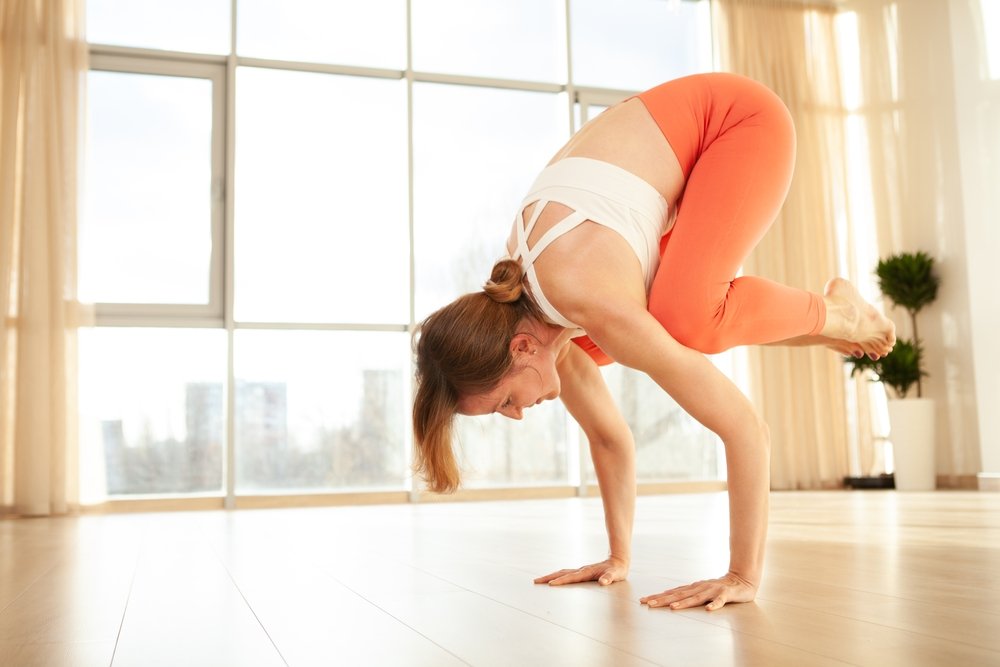
Good news, almost anyone can work toward the Bakasana Pose. What matters far more is understanding the technique. As long as you build up to it gradually and listen to your body, this pose is absolutely within reach even for complete beginners. In fact, poses like Crow Pose are a core part of our 200 Hour Yoga Teacher Training in Rishikesh, where students are guided step by step to build the strength, technique and confidence needed to achieve them.
Warm-Up Recommendations
Always warm up before attempting Crow Pose. A 10–15 minute warm-up should include:
- Sun Salutations (Surya Namaskar)
- Wrist circles and wrist stretches
- Core activation exercises (Boat Pose, Plank holds)
- Hip openers (Pigeon Pose, Lizard Pose)
Who Should Avoid Crow Pose?
Since this pose puts a good amount of pressure on your wrists, shoulders and core, certain health conditions or physical limitations mean you should either skip it for now or make some modifications.
- Wrist Injuries or Pain: If your wrists are weak, injured, or inflamed, putting your full body weight on them can make things worse and slow down your recovery. It’s best to give this pose a miss until your wrists feel strong and pain-free.
- Shoulder Pain or Instability: Your shoulders play a huge role in supporting and stabilising this pose. If you’re currently dealing with any shoulder pain or instability, attempting Crow Pose may worsen the condition further, so it’s better to wait until you’ve healed.
- Recent Surgery: Had a recent surgery, especially involving your wrists, arms, shoulders, or abdomen? Please be patient with your body and wait until you’re fully recovered before trying this pose. Your healing always comes first!
- Pregnancy: If you’re pregnant, it’s strongly advised to avoid Crow Pose altogether, or only practice it under the close guidance of a qualified yoga instructor, since the pose places direct pressure on the core and demands strong balance.
Key Takeaway
Crow Pose, or bakasana, is much more than just an arm balance. It’s a journey that offers a beautiful mix of strength, balance and learning to trust yourself a little more each day. Yes, it might feel challenging to reach at first, and that is completely okay. With regular practice, it slowly becomes more achievable.
Crow pose is all about control, awareness and staying present in the moment. That mindful connection between your body and breath is where the real magic happens.
So keep practising and trusting your body because your lift-off moment is already on its way.
Frequently Asked Questions
How long does it take to learn Crow Pose?
It depends on your practice consistency. Some people achieve their first lift in a few weeks, while others may take a few months. Regular practice is more important than speed.
What should I focus on first when learning Crow Pose?
Start with wrist strength, core engagement and hip flexibility. These three foundations make it much easier to find balance in the pose.
Why do my wrists hurt in Crow Pose?
Wrist pain usually comes from uneven weight distribution or a lack of warm-up. It’s important to spread your fingers wide, press evenly through the palms and prepare your wrists before practice.
Can Crow Pose help in other yoga poses?
Yes, Crow Pose builds a strong foundation for other arm balances like Side Crow, Crane Pose and Flying transitions, as well as improving overall core strength and focus.
Why do I keep falling forward in Crow Pose?
Falling forward usually happens because you are leaning too quickly or not controlling your balance point. It can also mean your core is not fully engaged. With practice, you learn how much to lean without losing control.
This article is for general information and is not medical advice. If you have a respiratory or heart condition, are pregnant, or are unsure whether these practices suit you, please speak to your doctor before beginning. Yoga poses and breathing exercises should be practiced with proper guidance from a qualified yoga teacher to help ensure safe and correct practice.