





How to Deepen Your Yoga Practice: 10 Practical Ways
Table of Contents
- What Does It Mean to Deepen Your Yoga Practice?
- 10 Ways to Deepen Your Yoga Practice
- 1. Set a Clear Intention Before You Practice
- 2. Build a Consistent Practice
- 3. Focus on Breath During Yoga
- 4. Improve Your Awareness in Yoga Poses
- 5. Practice Meditation and Mindfulness
- 6. Study Yoga Philosophy
- 7. Practice at a Level That Challenges You Without Forcing Your Body
- 8. Give Rest and Recovery a Real Place in Your Practice
- 9. Work With a Qualified Yoga Teacher
- 10. Take Yoga Beyond the Mat
- How Beginners Can Build a Strong Yoga Practice
- How to Improve Your Yoga Practice Over Time
- What Are the Benefits of a Regular Yoga Practice?
- How Often Should You Practice Yoga?
- Is Advanced Yoga Necessary to Deepen Your Practice?
- Final Thought
- Frequently Asked Questions
- What does it mean to deepen your yoga practice?
- How can I deepen my yoga practice at home?
- How often should I practice yoga to see progress?
- Can beginners develop a deep yoga practice?
- Do I need to learn advanced yoga poses to improve my practice?
- How can pranayama deepen my yoga practice?
- How can meditation complement yoga practice?
If you’ve been practicing yoga for a while and it suddenly feels flat, you’re not alone. A lot of students hit this point somewhere between month three and year two. The poses that used to feel challenging now feel routine, and there’s a feeling that something is missing.
The instinct is usually to chase harder yoga poses. Arm balances and deep backbends are fancier versions of what you already know but that’s often the wrong move, and it’s rarely what actually helps you deepen your yoga practice or get more out of the time you already spend on the mat.
Deepening your yoga practice has very little to do with difficulty. It has to do with attention, how present you are on the mat, how well you understand your breath, how consistent you show up, and whether you’re starting to connect yoga to anything beyond the physical shape you’re making with your body. This article walks through ten practical, realistic ways to do that, whether you’re just starting to practice yoga as a beginner or you’ve been at it for years and want more out of it.
What Does It Mean to Deepen Your Yoga Practice?
Deepening your yoga practice means developing more awareness, breath control, consistency, and understanding within the practice you already have, not necessarily adding harder poses to it. Understanding how to deepen yoga practice really starts with letting go of the idea that difficulty is the goal.
There’s a real difference between doing yoga poses, practicing yoga, and having a deeper practice. Doing poses is largely physical, moving the body into shapes, often chasing flexibility or a good stretch. Practicing yoga regularly adds structure and routine to that. A deeper practice adds something else again: attention to breath, honest awareness of what’s happening in the body and mind, and some understanding of why the practice exists in the first place.
Asana, the physical postures, is only one limb of yoga. Traditional yoga philosophy describes eight limbs in total, and asana is just one piece of a much larger system that also includes breath control, ethical conduct, concentration, and meditation. A student who holds a strong Warrior II but has never paid attention to their breath, or who practices five days a week but treats it purely as exercise, hasn’t necessarily gone deeper than someone practicing simple poses with full presence and steady breath.
Physical progress—more flexibility, more strength, and cleaner alignment is real and worth having. But it’s one part of the picture, not the whole thing.
10 Ways to Deepen Your Yoga Practice
There isn’t one single technique that deepens a practice. It’s a combination of habits and shifts in attention, built over time. Here are ten that actually make a difference.
1. Set a Clear Intention Before You Practice
Before you move into your first pose, take a moment to decide why you’re on the mat today. It doesn’t need to be elaborate. It might be as simple as “stay with my breath” or “notice when I start comparing myself to yesterday.”
An intention gives a session direction. Without one, it’s easy to lose focus during the sequence and move through the poses without being fully present. With one, even a short practice tends to feel more focused because you have something to return to when your attention moves away, which it will, repeatedly, and that’s normal.
2. Build a Consistent Practice
Consistency does more for a yoga practice than intensity ever will. Twenty minutes a day, most days of the week, will take you further than one exhausting two-hour class every Sunday.
This matters because the benefits of yoga build over time. Breath awareness, body awareness, and flexibility all build through repeated, regular exposure. A single long session gives you a good workout. A daily yoga practice, even a short one, gives your nervous system and your body time to actually absorb the work. The people who deepen their practice fastest usually aren’t the ones who practice yoga the longest in a single sitting; they’re the ones who practice yoga most consistently, in whatever amount of time they actually have.
If daily practice feels unrealistic right now, that’s fine. Three or four sessions a week is a solid starting point. What matters most is building a regular habit. Try to practice around the same time each day and, if possible, in the same place. Make it easy to practice so that skipping a session becomes the exception, not the usual thing.
3. Focus on Breath During Yoga
Most students learn the poses before they learn how to breathe properly while holding them. That’s backwards, and it’s one of the biggest reasons practices stay limited.
In most yoga styles, breath and movement are meant to move together, you inhale into a stretch and exhale into a fold or a twist. When that connection is missing, a pose becomes just a stretch. When it’s present, the same pose becomes something closer to moving meditation.
You don’t need to master formal pranayama, the yogic science of breath regulation, to benefit from paying closer attention to your breath. Start simply: notice if your breath is shallow, held, or rushed during a pose. Slow it down and let the exhale be as long as the inhale, or slightly longer. Once that basic awareness is steady, techniques like alternate nostril breathing or Ujjayi breath become genuinely useful rather than just something you’re copying from a teacher.
4. Improve Your Awareness in Yoga Poses
Performing a pose and understanding a pose are two different skills. A student can hold a technically correct triangle pose while completely disconnected from what’s happening in their hips, their breath, or their weight distribution.
Awareness in a pose means noticing alignment without worrying too much about it, feeling where the effort is coming from, sensing which muscles are working and which are being asked to relax, and staying honest about your own limit instead of measuring it against the person on the next mat. Comparison is one of the fastest ways to shut down awareness; it pulls your attention outward right when the practice is asking you to look inward.
This kind of attentiveness is what separates someone who’s “done yoga for ten years” from someone who’s actually developed a deep relationship with their yoga poses. It’s slower to build than flexibility, and it’s also more durable.
5. Practice Meditation and Mindfulness
Meditation and asana aren’t separate practices joined together, they support each other. The concentration you build sitting still for ten minutes carries directly into how present you are on the mat, and the body awareness you build through asana makes it easier to sit still without moving around or losing focus.
You don’t need a long, formal meditation session to get something from this. Five quiet minutes before or after your physical practice, just watching the breath, is enough to start. Over time, that same quality of attention starts showing up off the mat too, in a conversation, in traffic, in the everyday challenges of a normal day. That carryover is one of the clearest signs a practice is deepening.
6. Study Yoga Philosophy
Yoga is more than physical exercise, and understanding a bit of its philosophy changes how the physical practice feels. You don’t need years of study for this, a working knowledge of a few core ideas goes a long way.
The yamas and niyamas, the ethical guidelines that open the eight-limbed path, are a good place to start. Ahimsa, non-harming, applies just as much to how you treat your own body on the mat as it does to how you treat other people, pushing into pain isn’t dedication, it’s a violation of a basic principle. Santosha, contentment, is the practice of being okay with where your body is today instead of constantly reaching for where you think it should be. Svadhyaya, self-study, is simply paying honest attention to your own patterns, on and off the mat.
None of this needs to turn into an academic exercise. Reading a little, reflecting on it, and letting it quietly shape how you show up to practice is enough. If you want a fuller picture of the whole system, our breakdown of the eight limbs of yoga is a reasonable next step.
7. Practice at a Level That Challenges You Without Forcing Your Body
There’s a useful balance in yoga, enough effort to keep you engaged and building capacity, without pushing too hard. Finding that edge is a skill, and it’s different every day, depending on sleep, stress, and how your body feels that morning.
Forcing a pose past what your body is ready for doesn’t deepen your practice. It usually just creates tension, sometimes injury, and almost always disconnects you from your breath, which is the opposite of what you’re trying to build. Real progress, and most of the genuine benefits of yoga, tend to come from working close to your limit consistently, not from occasionally forcing past it.
If a pose isn’t available to you yet, that’s information, not failure.
8. Give Rest and Recovery a Real Place in Your Practice
It’s easy to treat rest as the absence of practice rather than part of it. Savasanaat the end of a session, or a full rest day after a demanding week, isn’t wasted time, it’s when the nervous system actually processes the work you’ve just done.
Skipping Savasana to save five minutes, or practicing hard every single day without a break, tends to backfire. The body doesn’t get the chance to take in anything, and awareness starts to dull rather than sharpen. Building in planned rest, even one lighter or fully restful day a week, is part of what makes the rest of the practice sustainable.
9. Work With a Qualified Yoga Teacher
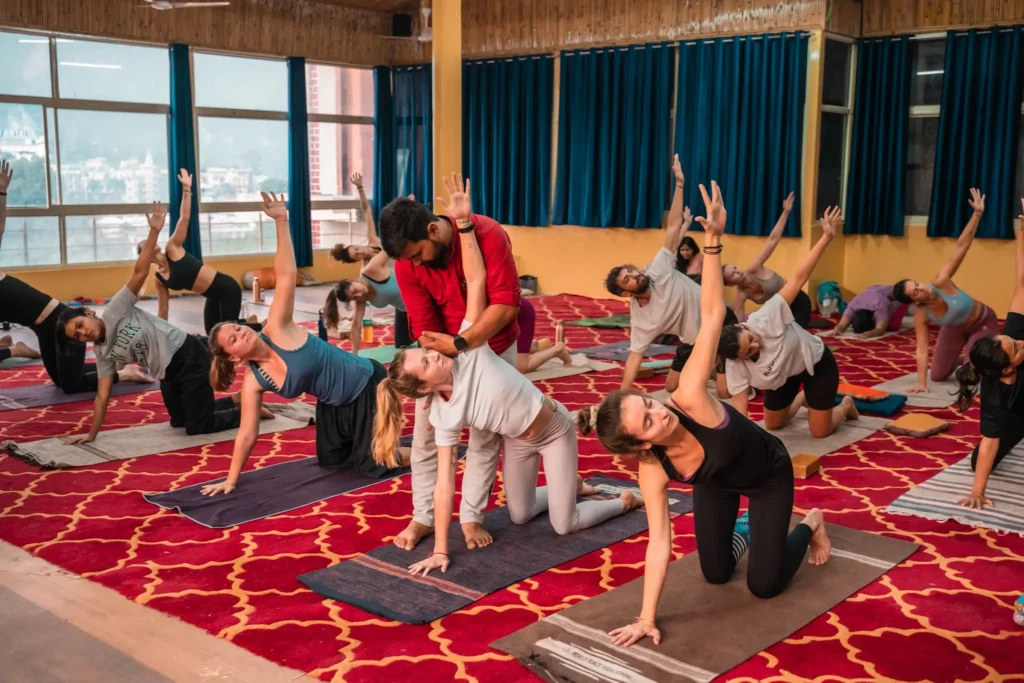
Books and videos can only teach you so much. A qualified teacher can notice things you may not notice yourself, like a hip that is slightly out of place, a shoulder moving up toward your ear, or your breathing becoming tight instead of relaxed. That kind of feedback speeds up progress in a way that solo practice can’t always match.
A good teacher also helps with pacing, sequencing, and knowing when you’re actually ready to progress versus when you’re just impatient. If you want structured, immersive guidance, the philosophy and breathwork side of practice, not just the poses, a residential course such as yoga teacher training in India or yoga teacher training in Bali is built around exactly that kind of depth, even for students who have no intention of teaching afterward.
10. Take Yoga Beyond the Mat
The clearest sign of a deepening practice is that it stops staying on the mat. Ahimsa shows up in how you talk to yourself when you’re frustrated. Santosha shows up in how you handle a bad day. Self-discipline shows up in whether you keep a commitment to yourself even when nobody’s watching. Awareness shows up in noticing your own reactions before you act on them.
This is also where karma yoga, the practice of selfless action, becomes relevant, yoga used to how you engage with the people and responsibilities around you, not just how you move on a mat.
Read More: Karma Yoga: Meaning, Benefits & How to Practise It
How Beginners Can Build a Strong Yoga Practice
If you’re newer to yoga for beginners, deepening your practice starts long before advanced poses are even relevant. A few things matter far more early on:
- Start with manageable sessions — 15 to 20 minutes is enough to build a real habit.
- Learn foundational poses properly before layering complexity on top of them.
- Pay attention to your breath from day one, even if the poses feel basic.
- Avoid comparing your practice to more experienced practitioners in a class; you only see their current pose, not the years of practice behind it.
- Build consistency before you chase flexibility. Flexibility follows consistency, not the other way around.
- Give your body time to adapt. Tight hamstrings and stiff shoulders loosen gradually, not in a week.
- Ask a qualified teacher when something feels off, rather than pushing through confusion.
- Introduce meditation and breathwork gradually once the physical routine feels stable.
A beginner who practices yoga attentively three times a week is often building a deeper foundation than someone with years of experience who’s practicing without much attention. Yoga for beginners isn’t about doing less, it’s about paying more attention to what you’re already doing.
How to Improve Your Yoga Practice Over Time
If you’re looking to improve your yoga practice without simply adding harder poses, the markers below are a better measure than flexibility alone:
- Steadier, more controlled breathing during effortful poses.
- Longer periods of focused attention, both on and off the mat.
- Less need to compare yourself to others in a class.
- Better understanding of alignment, so poses feel more stable rather than just more advanced.
- More patience with slow progress, instead of treating it as failure.
- A growing, practical grasp of yoga philosophy that quietly shapes daily decisions.
If your practice is changing in these ways, it’s improving, even on weeks where nothing about your flexibility has moved at all.
What Are the Benefits of a Regular Yoga Practice?
The benefits of yoga are well documented, though it’s worth being precise about what regular practice can realistically offer rather than making broad claims.
- Better mobility and flexibility
- Improved strength and balance
- Greater body awareness
- Better stress management
- Improved focus and concentration
- A greater sense of calm
- More discipline and consistency
It’s worth being clear that yoga isn’t a treatment for medical conditions, and results vary from person to person depending on body, history, and how the practice is approached. If you have a health concern, talk to a doctor instead of relying on a blog.
How Often Should You Practice Yoga?
There’s no single frequency that’s correct for everyone. What matters more is that the frequency you choose is one you can actually sustain.
A short daily yoga practice, even 15 to 20 minutes, works well for people who want steady, gradual progress. Three to four sessions a week suits people with busier or less predictable schedules, and still builds real consistency over months. Longer sessions on weekends, combined with shorter weekday practices, work for people who have more time on certain days than others.
The honest answer is that the best schedule is one you can follow regularly, not one that is too difficult to maintain.
Is Advanced Yoga Necessary to Deepen Your Practice?
No. Advanced yoga poses are not necessary to deepen your yoga practice.
This is probably the single biggest misconception around the whole topic. A deep practice is built through awareness, breath, consistency, and understanding, none of which require a particular pose. Someone practicing a handful of foundational poses with full attention and steady breath has, in a meaningful sense, a deeper practice than someone performing a difficult arm balance while holding their breath and thinking about something else entirely.
Advanced poses can be a satisfying part of a long-term practice, and there’s nothing wrong with working toward them. But you don’t need advanced poses to have a deep and meaningful yoga practice.
Final Thought
None of the ten things covered here require a harder pose, a more flexible body, or years of experience. They require attention, showing up consistently, breathing with intention, staying honest about what your body can do today instead of chasing what it might do eventually, and letting a little of the philosophy behind yoga actually guide the way you practice.
That’s true whether you’re three weeks into your first regular practice or ten years into a routine that has become a habit. Depth isn’t a milestone you eventually reach. It’s a quality you bring to whatever practice you’re already doing, one session at a time. Some days that will look like real progress. Other days it will just look like showing up anyway, and that is just as important.
Frequently Asked Questions
What does it mean to deepen your yoga practice?
It means building more awareness, breath control, consistency, and understanding of yoga philosophy within your existing practice, rather than adding more difficult poses to it.
How can I deepen my yoga practice at home?
Set a realistic, repeatable schedule, pay close attention to your breath during poses, add a short meditation session before or after practice, and stay honest about your body’s limits instead of forcing a stretch.
How often should I practice yoga to see progress?
Most practitioners see steady progress with three to five sessions a week, though a short daily practice tends to build consistency and awareness faster than occasional long sessions.
Can beginners develop a deep yoga practice?
Yes. Depth comes from attention and consistency, not experience level. A beginner practicing mindfully can develop real depth faster than an experienced practitioner going through the motions.
Do I need to learn advanced yoga poses to improve my practice?
No. Improvement shows up in breath control, body awareness, consistency, and understanding; advanced poses aren’t required for any of that.
How can pranayama deepen my yoga practice?
Breath regulation calms the nervous system and sharpens concentration, which makes it easier to stay present during asana and carries that same steadiness into meditation and daily life.
How can meditation complement yoga practice?
Meditation builds the same quality of sustained attention that a deep asana practice requires, and the body awareness built through asana makes it easier to sit still and focus during meditation.
This article is for general information and is not medical advice. If you have a respiratory or heart condition, are pregnant, or are unsure whether these practices suit you, please speak to your doctor before beginning. Yoga poses and breathing exercises should be practiced with proper guidance from a qualified yoga teacher to help ensure safe and correct practice.