





8 Desk Yoga Moves That Help Burn Calories During Workday
Table of Contents
- What Really Happens to Your Body When You Sit for Hours?
- 8 Office Yoga Moves That Burn Calories
- 1. Chair Warrior I (Virabhadrasana I Variation)
- 2. Desk Plank Push (Chaturanga-Inspired)
- 3. Extended Triangle Pose (Utthita Trikonasana)
- 4. Seated Spinal Twist (Ardha Matsyendrasana)
- 5. Standing Forward Fold With Shoulder Opener
- 6. Standing Hip Circles (Kati Chakrasana Variation)
- 7. Seated Cat-Cow With Core Engagement (Marjaryasana-Bitilasana Variation)
- 8. Desk Upward Dog (Urdhva Mukha Svanasana Variation)
- What Actually Happens to Your Body When You Do This Every Day
- Final Thought
- Frequently Asked Questions
- Can desk yoga actually help with weight loss?
- Is desk yoga suitable for older adults?
- Is it good for lower back pain?
- Do I need a mat?
- How often should I do this to see results?
- I have not exercised in years – can I still do this?
Be honest, when did you last actually move? Not walk to grab a coffee or walk to a meeting, but genuinely stretch and give your body a moment to breathe.
If you cannot remember, you are not alone. Most of us spend the majority of our workday stuck in a chair, half-aware that something feels off but too busy to do anything about it. We tell ourselves we will stretch after this call, after this email. That moment never comes.
Then the lower back ache arrives by mid-afternoon. That is not just getting older; that is your body reacting to hours of sitting hunched over a screen. Your neck and spine were never designed to hold that position for so long. Over time, the stiffness, tension, and discomfort quietly become your new normal.
This is exactly why more people are now turning toward desk yoga for office workers, office yoga stretches, and simple daily stress relief yoga practices that fit into real life instead of unrealistic fitness routines.
Here is what nobody tells you: you do not need a gym membership, a standing desk, or a 6 AM run to fix this. You just need to move a little, regularly, in ways that actually fit into a real working day.
Simple movements like chair yoga for stress relief, gentle stretching, and yoga for posture correction can help release tight hips, reduce neck and shoulder tension, improve circulation, and ease the physical stress created by long hours of sitting.
These 8 yoga moves are simple, quick, and built for real office life. They might just be the smallest habit that changes everything.
What Really Happens to Your Body When You Sit for Hours?
Your chair is comfortable. That’s the problem.
After a few hours at your desk, your body starts sending quiet signals that something is wrong. Your neck stiffens, and even your breathing becomes shallower without you noticing.
Research published by the National Institutes of Health suggests that spending long hours sitting without regular movement may negatively affect circulation, increase muscle stiffness, and place extra strain on the spine and surrounding muscles. Over time, prolonged inactivity has also been associated with poor posture, lower energy levels, and an increased risk of several health problems associated with inactive lifestyles. The problem is not the sitting itself, but staying in one position for too long without movement.
This is where desk yoga for office workers, office yoga stretches, and chair yoga for stress relief can make a surprisingly powerful difference, especially when supported by the deeper understanding gained through Yoga Teacher Training in India.
| Hours of Sitting Per Day | Metabolic Impact | Associated Health Risks |
| Under 4 hours | Minimal | Low |
| 4-6 hours | Moderate metabolic slowdown | More tiredness and a small risk of weight gain. |
| 6-8 hours | Daily movement drops noticeably, and the body can start feeling stiff and less active. | Increased risk of poor metabolism, stiffness and low energy. |
| 8+ hours | The body stays inactive for long periods, slowing calorie burn and reducing circulation. | Higher risk of obesity, heart problems, poor posture, depression and ongoing body pain. |
8 Office Yoga Moves That Burn Calories
1. Chair Warrior I (Virabhadrasana I Variation)
Best for: Anyone with a small amount of clear floor space beside their desk
Why It Burns: Warrior I activates your thigh muscles, glutes, hip flexors, core, and shoulders simultaneously – making it one of the most effective office yoga stretches for activating large muscle groups during the workday.
How To Do It:
- Stand behind the chair and lightly hold the chair’s backrest for support
- Step your right foot back about 3 feet while keeping your left foot facing forward
- Bend your left knee and keep it above your ankle
- Keep your right leg straight and press the outer edge of your right foot into the floor
- Raise both arms overhead, with your palms facing each other
- Keep your chest lifted and breathe slowly
- Hold for 45–60 seconds
- Repeat on the other side
Office Modification: Keep your arms lower (hands on hips) if overhead movement feels uncomfortable. The legwork is doing the heavy lifting either way.
Time Needed: 2 minutes total (both sides)
Calorie Focus: Thigh muscles, glutes, shoulders, three of your body’s largest muscle groups
2. Desk Plank Push (Chaturanga-Inspired)
Best For: Remote workers or anyone with a sturdy, stable desk
Why It Works: This move works your chest, triceps, core, and shoulders while helping improve posture and stability. It is especially effective for people searching for daily stress relief yoga that also supports strength and energy.
How To Do It:
- Stand facing your desk, roughly 2–3 feet back from it.
- Place both palms flat on the desk edge, shoulder-width apart.
- Walk your feet back until your body forms a straight diagonal line like a standing plank.
- Hold this position for 15 seconds, engaging your core and keeping your hips level.
- From there, lower your chest toward the desk in a slow, controlled push-up.
- Press back to the starting plank position.
- Repeat 8–10 reps, rest 20 seconds, then do another set.
Office Modification: The closer your feet are to the desk, the easier the angle. Move them further away to increase intensity.
Time Needed: 3–4 minutes (2–3 sets)
Calorie Focus:Chest, triceps, core, shoulders
Read More: Plank Pose (Phalakasana): Steps, Benefits, and Common Mistakes
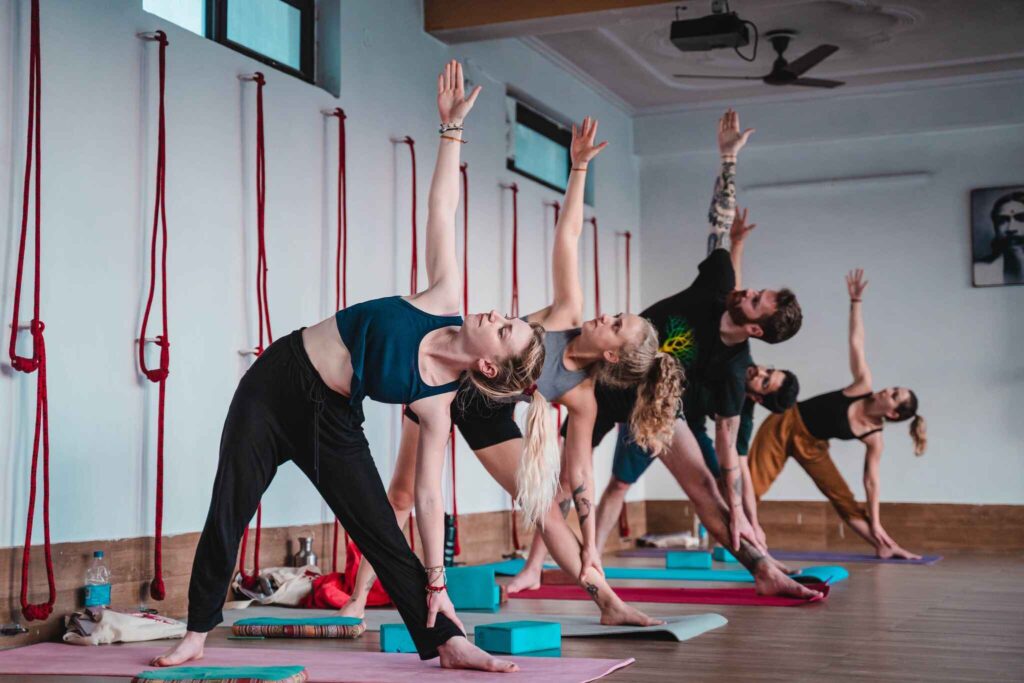
3. Extended Triangle Pose (Utthita Trikonasana)
Best For: People with tight outer thighs, anyone who has lower back pain that spreads into one side, and anyone who wants a standing pose that looks calm and controlled from the outside
Triangle Pose is one of the most underrated yoga for posture correction movements because it strengthens the legs while improving spinal alignment and mobility. It is also highly effective for yoga for tight hips and lower back tension caused by prolonged sitting.
How To Do It:
- Stand with feet approximately 3 to 4 feet apart, in a wide position, beside your desk.
- Turn your right foot to the right. Keep your left foot facing mostly forward, with the toes slightly turned in.
- Extend both arms out at shoulder height.
- Breathe out and slowly bend to your right side. Reach your right hand toward your lower leg, ankle, or the floor, wherever you can comfortably reach. Keep your back straight and do not bend too far just to reach the floor.
- Reach your left arm directly upward toward the ceiling, keeping it above your right arm. Turn your gaze to look up at your left hand, or keep it neutral if your neck prefers.
- Both legs remain completely straight. The work is in the stability, the stretch, and the rotation, not in the depth of the reach.
- Hold for 45–60 seconds. Come back up on an inhale. Switch sides.
Office Modification: Place your lower hand on your lower leg or knee. If the floor is not accessible, the pose works fully at any height. A chair can be placed beside you as a light balance support.
Time Needed: 2–3 minutes (both sides)
Calorie Focus:Muscles at the back and inside of your thighs, outer thighs, waist, lower back, and upper back.
4. Seated Spinal Twist (Ardha Matsyendrasana)
Best For: The 3 PM low energy, post-lunch sluggishness, or any moment your lower back starts quietly showing distress
This gentle twist is one of the best forms of chair yoga for stress relief because it helps relax thespine, improve circulation, and release tightness stored in the back and waist. For people experiencing screen fatigue or long hours at a desk, this pose helps improve easy movement while supporting digestion and reducing stiffness.
How To Do It:
- Sit tall in your chair, both feet flat on the floor.
- Place your right hand on your left knee and your left hand on the back of your chair or armrest.
- On an exhale, gently rotate your upper body to the left, leading from the base of the spine, not just the shoulders.
- Keep your chin level (don’t let your head drop forward).
- Hold for 5 slow breaths, roughly 30 seconds.
- Return to the centre slowly. Switch sides.
Office Modification: This looks like someone shifting position in their chair. Nobody will notice. This is your most hidden move.
Time Needed: 2 minutes (both sides, with breath)
Calorie Focus: Muscles on the sides of your waist and back, with possible benefits for digestion and hormone health.

5. Standing Forward Fold With Shoulder Opener
Best For: Tension headaches, mid-afternoon brain fog and anyone who types more than four hours a day.
This pose is especially beneficial for people seeking yoga for screen fatigue, stress relief, and posture correction. As you fold forward, the spine relaxes, the neck softens, and the upper back begins to release the tension built up from hours of sitting and staring at screens. The added shoulder opener stretches the chest and front shoulders, areas that become tight from constant desk work and poor posture.
How To Do It:
- Stand with your feet about hip-width apart and stand a little away from your desk or wall.
- Put your hands together behind your lower back and if you cannot do this, hold a rolled-up jacket with both hands.
- Take a deep breath in and lift your chest.
- Breathe out and slowly bend forward from your hips.
- As you bend forward, let your arms move up behind you.
- Let your head and neck relax. Do not tighten them.
- Stay here for 45–60 seconds and breathe slowly.
- To come back up, let go of your hands and place them on your thighs. Slowly stand up.
Office Modification: If the full fold is too much, do a gentle half-fold, hands on your thighs, back straight and level with the floor. The shoulder opener still works.
Time Needed: 90 seconds
Calorie Focus: Muscles at the top and back of your shoulders, the back of your thighs, and along your back.
6. Standing Hip Circles (Kati Chakrasana Variation)
Best For: Anyone feeling stiff and locked through the hips and lower back, especially useful in the first 10 minutes of the workday or after a long meeting
Hip circles are highly effective for improving joint mobility and reducing tightness caused by prolonged sitting. They are especially useful for people searching for yoga for tight hips and lower back.
This movement also improves circulation and gently wakes up the deep core muscles that become inactive during long workdays.
How To Do It:
- Stand with your feet about hip-width apart.
- Put your hands on your hips, you can also hold the edge of your desk for support.
- Slowly move your hips in a small circle and then move them forward, to the right, back, and then to the left.
- Keep your upper body as still as you can and let your hips do the movement.
- Slowly make the circles a little bigger, but only move as far as feels comfortable.
- Make 8–10 circles in one direction.
- Stop, then make 8–10 circles in the other direction.
Office Modification: This can be done seated; if standing isn’t possible, the movement is slightly less effective but still meaningful, particularly for the lumbar spine.
Time Needed:2–3 minutes
Calorie Focus: Muscles at the front and back of your hips, muscles that help turn your hips, deep belly muscles, and inner thighs, while also helping your hip joints move smoothly.
7. Seated Cat-Cow With Core Engagement (Marjaryasana-Bitilasana Variation)
Best For: The first 30 minutes of the morning, anyone with chronic lower back stiffness, and remote workers who wake up and go directly from bed to desk
Seated Cat-Cow is one of the simplest yet most effective office yoga stretches because it moves the whole spine while improving posture and breathing.
It is also excellent daily stress relief yoga because the coordinated breathing naturally calms the nervous system and releases tension stored in the body.
How To Do It:
- Sit toward the front edge of your chair with your feet flat on the floor, hip-width apart and place your hands on your knees
- Cow position: Breathe in as you lift your chest, gently curve your back and look slightly upward
- Cat position: Breathe out as you round your back, bring your chin toward your chest and gently pull your belly in
- Slowly move between these two positions, breathing in as you lift your chest and breathing out as you round your back
- Keep breathing throughout the movement and do not hold your breath
- Repeat 10–15 times, making the movement a little longer each time if it feels comfortable
Office Modification:This is entirely seated and invisible at a glance. It looks like someone is shifting positions. It can be done anywhere, any time, including during a one-on-one call if your camera is off.
Time Needed: 2–3 minutes (10–15 breath cycles)
Calorie focus: Muscles along your spine, deep belly muscles, muscles that support your back, side waist muscles, and upper back movement.
8. Desk Upward Dog (Urdhva Mukha Svanasana Variation)
Best For: Anyone whose chest collapses forward over a keyboard, people with chronic upper back tightness, and anyone who finishes the workday feeling physically smaller than when they started
Why It Is Powerful: When you press into the desk and extend your spine backwards, your erector spinae and glutes all fire together to create and hold the backbend. The result is immediate: people consistently describe a sense of physical expansion like their spine just remembered it was supposed to be long.
This exercise is also one of the highest-energy moves in this list. The combination of spinal extension, arm engagement, and full-body hold recruits enough muscle to meaningfully elevate your heart rate within the first 30 seconds.
How To Do It:
- Stand facing your desk, about 2–3 feet away, and place both hands flat on the edge of the desk
- Move your feet back until your body forms a diagonal line (slanting line), with your arms straight and your hips slightly lower than your shoulders
- Breathe in and slowly move your hips forward and down toward the desk, lifting your chest and gently leaning your back
- Push down on the desk with your hands and keep your arms straight, then look slightly up without putting strain on your neck
- Keep your legs strong and gently tighten your hip muscles to support your lower back
- Stay here for 5–8 slow breaths, then breathe out and slowly move your hips back to the starting position
- Repeat 2–3 times
Office Modification: If the full backbend feels like too much initially, keep the movement subtle, just a mild chest lift and gently bend your back. As your upper back becomes more flexible, you can slowly bend a little more over time.
Time Needed: 2–3 minutes (2–3 rounds)
Calorie Focus: Back muscles, shoulder muscles, hip muscles, and arm muscles; strong use of the muscles along the back of your body.
What Actually Happens to Your Body When You Do This Every Day
| Timeline | What You Feel | What is Actually Happening Inside? |
| Days 1-3 | A mild sense of relief after each movement break. Slightly less stiff when you stand up | Blood is circulating to muscles that have been sitting in the same position for hours. The hip muscles and lower back get their first real signal to release. |
| Week 1 | Lower back tightness in the afternoon reduces noticeably. Falling asleep at night feels a little easier. | Muscle tension that normally accumulates throughout the day is being discharged in real time through movement. Your nervous system ends the day calmer. |
| Week 2 | Your posture starts shifting – often noticed by someone else before you notice it yourself. Shoulders sit slightly lower and further back. | The chest muscles that shorten from keyboard work are being stretched daily. The upper back muscles that weaken from rounding are being activated. The body is finding balance. |
| Month 2 | Overall energy is more stable across the full workday. Lower back pain is significantly reduced or gone. Sleep quality has improved consistently. | The muscles that help you keep good posture are now stronger. The deep core and back muscles that protect your lower back are now doing their job properly, possibly for the first time in years. |
Final Thought
Now that you’ve read this far, you already know what your body has been trying to tell you, and if we’re being honest, you’ve probably felt genuinely motivated for the last few minutes, nodding along, thinking yes, this is the year I actually take care of myself. Just don’t let life interfere.
Don’t let a long meeting or other work make you leave this for tomorrow. “You just need to start small, simple, and today.” Pick one move, do it consistently, and let your body remember what it feels like to actually breathe through a workday.
Frequently Asked Questions
Can desk yoga actually help with weight loss?
Yes, but keep expectations realistic. It burns calories directly through movement and reduces cortisol, which lowers your body’s signal to store fat. It will not replace a full workout, but it meaningfully supports weight management when done consistently.
Is desk yoga suitable for older adults?
Yes. Many desk yoga exercises are beginner-friendly and gentle, making them suitable for older adults or people returning to movement after a long break. The key is to move gently and avoid forcing any position.
Is it good for lower back pain?
Yes. The Seated Spinal Twist, Hip Circles, and Cat-Cow directly target the three main causes of desk-worker back pain: spinal compression, tight hip flexors, and hamstring stiffness.
Do I need a mat?
No. Every move in this article was chosen specifically so that no mat is required. Flat, stable ground is all you need.
How often should I do this to see results?
Three to five short breaks per workday beat one long session. Start with two breaks – morning and after lunch – then build from there. Consistency matters more than intensity.
I have not exercised in years – can I still do this?
Absolutely. Start with the Seated Spinal Twist and Cat-Cow — both are done in your chair and are gentle enough for complete beginners. Many beginner wellness programs at Samadhi Yoga Ashram also focus on simple foundational movements before progressing into deeper practices. Add one standing move per week as you build confidence.
This article is for general information and is not medical advice. If you have a respiratory or heart condition, are pregnant, or are unsure whether these practices suit you, please speak to your doctor before beginning. Yoga poses and breathing exercises should be practiced with proper guidance from a qualified yoga teacher to help ensure safe and correct practice.