Download the PDF
The full Vivekananda translation and commentary. Opens directly, no email, no sign-up.





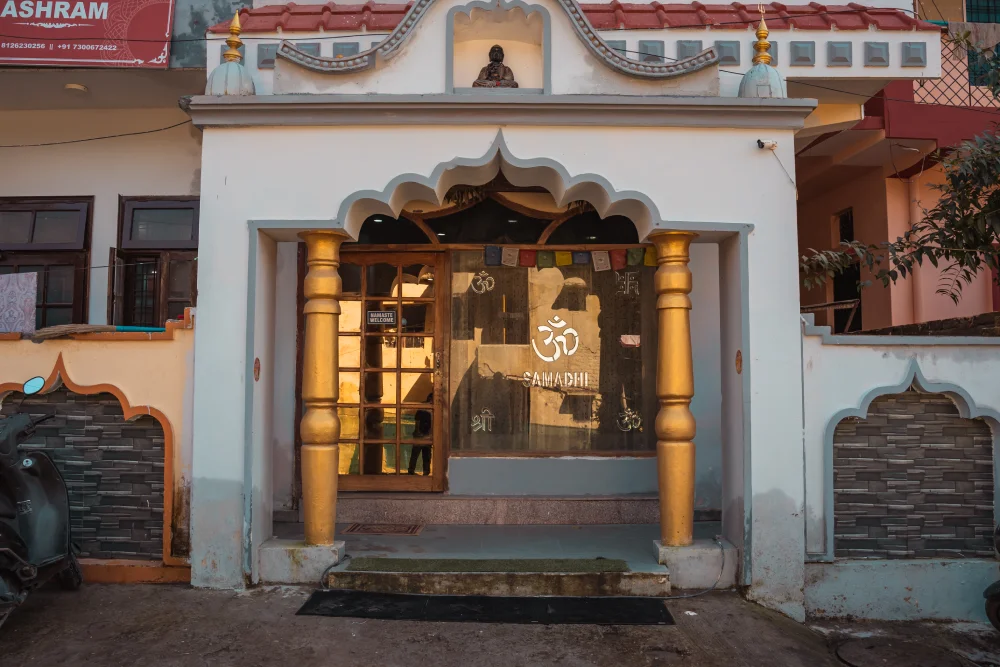
Patanjali's Yoga Sutras (196 short verses written some time between 200 BCE and 400 CE) remain the most-studied text in classical yoga. Swami Vivekananda's 1896 translation, included here as a free PDF, is one of the clearest English entry points to the work. It is one of the foundational texts on the syllabus at Samadhi Yoga Ashram. Read in the 200 hour and 300 hour Yoga Teacher Trainings in Rishikesh.
The full Vivekananda translation and commentary. Opens directly, no email, no sign-up.
The sutras open differently when read inside a residential training, with a teacher unpacking each verse over chai.
About the text
The Yoga Sutras are an aphoristic text, very short verses, each meant to be unpacked and meditated on rather than read quickly. Patanjali did not invent yoga; he organised what was already an ancient practice into a systematic eight-limbed path (ashtanga yoga): yama, niyama, asana, pranayama, pratyahara, dharana, dhyana and samadhi.
Where many texts of the period were devotional or speculative, Patanjali wrote in the style of a manual. The sutras name what gets in the way of clarity (the kleshas, the obstacles, the wanderings of the mind), describe practices that steady it (eight limbs, kriya yoga), and chart the states that follow when the practice deepens (samadhi).
Swami Vivekananda's translation, first published as part of his book Raja Yoga in 1896. Was one of the first English presentations to take the text seriously as practical instruction rather than as a curiosity. His commentary is direct, occasionally blunt, and grounded in his own years of practice with Sri Ramakrishna. It remains a strong companion for anyone reading the sutras for the first time.
In our trainings
We treat Patanjali not as theory to memorise, but as the map that explains why the rest of practice works the way it does. The text appears at three different depths across our teacher trainings.
Samadhi Pada is read across the philosophy module, paired with daily reflection. The first ten sutras are studied closely. What is yoga, what is the mind doing when it isn't yoga, and what is the practitioner aiming for. Most students leave with a working understanding of the eight limbs.
All four chapters are studied in full. We work verse by verse through Sadhana Pada (the eight limbs in detail), Vibhuti Pada (concentration and its consequences) and Kaivalya Pada (liberation). Daily commentary sessions; assigned passages to teach back.
Selected sutras from Samadhi Pada and Vibhuti Pada anchor the meditation module, especially Patanjali's progression from dharana to dhyana to samadhi, which sets the framework for how we teach kundalini sadhana.
A small taste
"Yogas chitta vritti nirodhah.". Yoga is the stilling of the changing states of the mind.
— Yoga Sutra 1.2
The whole text is, in a sense, a footnote to this one verse. If you understand sutra 1.2 deeply, the rest of the book is commentary. Vivekananda's translation here is unusually direct. He doesn't soften "stilling" into "harmonising" or "balancing", which other translators sometimes do.
"Sthira sukham asanam.", The posture should be steady and comfortable.
— Yoga Sutra 2.46
The entire definition of asana in Patanjali, one line. Worth holding next to any modern asana you find difficult: is it steady? is it comfortable? if not, where exactly does it stop being so? This is the sutra that quietly corrects most aggressive practice.
"Tatra pratyaya ekatanata dhyanam.", The unbroken flow of attention on the object is meditation.
— Yoga Sutra 3.2
Patanjali's definition of dhyana, meditation as a continuity of attention, not a state of blankness. We teach this in the meditation module of every YTT, because it dissolves a lot of the confusion students arrive with about what meditation is supposed to feel like.
Frequently asked
Yes, the PDF opens directly with no email required. The text is Swami Vivekananda's classical translation and commentary, which is in the public domain. We host it as part of our free yoga library because it is one of the foundation texts studied at the ashram.
This is Swami Vivekananda's translation, originally published in his book Raja Yoga (1896). It covers all 196 sutras across the four padas (samadhi, sadhana, vibhuti and kaivalya) with Vivekananda's own commentary in plain English. The translation is one of the most widely read introductions to Patanjali outside India.
There are 196 sutras divided into four chapters (padas). Samadhi Pada (51 sutras) defines yoga and the goal of practice. Sadhana Pada (55 sutras) lays out the eight limbs. Vibhuti Pada (55 sutras) covers the powers that arise from concentration. Kaivalya Pada (34 sutras) describes liberation.
You can begin alone. Patanjali himself called self-study (svadhyaya) a niyama. But the sutras are intentionally compressed; a single line can hold a chapter's worth of meaning. Most students find that even the first 50 sutras open differently when read with a teacher who has practised them.
The first chapter is studied across the philosophy module of our 200 Hour Yoga Teacher Training in Rishikesh. All four chapters are studied in full, verse by verse, in the 300 Hour Yoga Teacher Training. Selected sutras appear in our Kundalini and Online programs.
Read the first ten sutras (1.1–1.10) twice. Slowly. Then read Vivekananda's introduction. Don't try to finish the book in one sitting. If anything confuses you, that is the right place to mark and bring to a teacher. The sutras reveal themselves over years, not weeks.
Study Patanjali with a teacher
Begin with Vivekananda's translation if it helps. When you are ready, the Yoga Sutras are read in full at our 300 Hour Yoga Teacher Training in Rishikesh, and across the philosophy module of the 200 Hour YTT.
If you have any queries about courses at Samadhi Yoga Ashram, please reach out. Our team usually replies within 24 hours and can help with course details, schedules, accommodation, payment options and travel logistics.
Other Courses You May Want
Also Available In Bali
Learn From Home - Online Courses
Short Retreats In Rishikesh

Shubh Deepavali
Light every lamp to open the temple doors — a Diwali gift for your practice is waiting inside.
Light all five diyas to open the doors
Tap each diya to light it · 0 of 5
You can also message us on WhatsApp with this code.
Valid for the November batch · one claim per student