





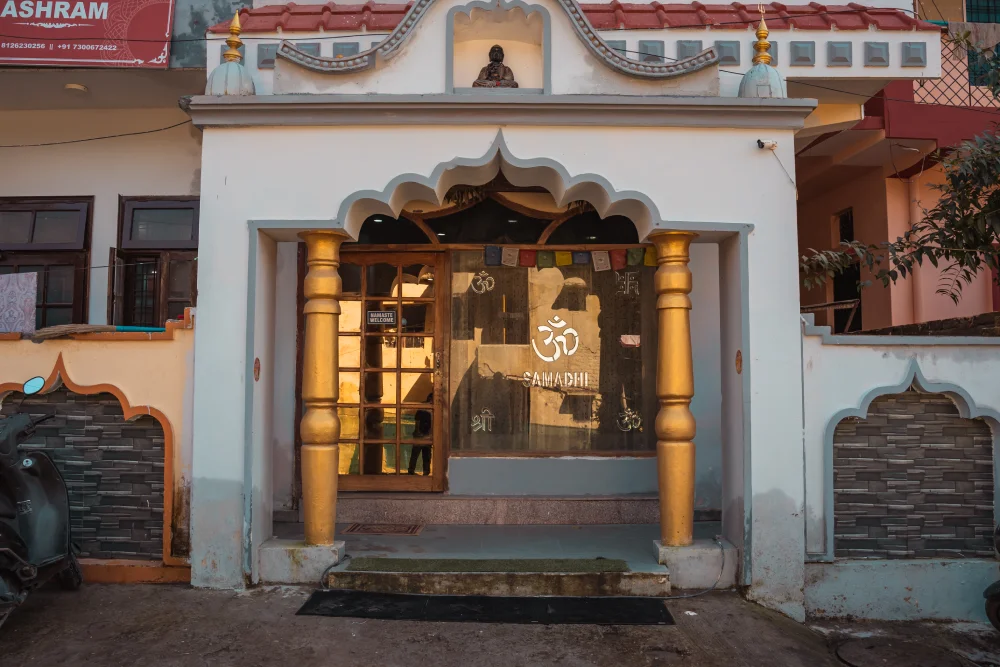
Meditation and Its Methods is a short volume drawn from Swami Vivekananda's lectures and writings on meditation, edited together by Swami Chetanananda. It is the book we usually hand to a guest who has never meditated before: clear, honest about the difficulty, and short enough to read in an evening. It is the recommended pre-reading for our Yoga and Meditation Retreat in Rishikesh.
Or sit with us
Reading about meditation gets you a few miles. Actually sitting in a hall in the Himalayas for a week gets you the rest.
About the text
What is Meditation and Its Methods?
Swami Vivekananda was a disciple of Sri Ramakrishna and one of the first Indian teachers to give a serious account of yoga and meditation to a Western audience, through his lectures in the United States and England in the 1890s. He did not write a single dedicated book on meditation. What we now read as Meditation and Its Methods is a collection of passages on meditation, drawn from his many lectures and letters, edited together posthumously by Swami Chetanananda of the Ramakrishna Order.
The result is unusually accessible. Vivekananda's voice is conversational, sometimes blunt. He was speaking to packed halls of curious newcomers, not specialists. He explains what meditation is and isn't; what gets in the way (the wandering mind, the body's fidgeting, the impatience); what posture, breath and concentration look like in practice; and what the long path of a sustained meditation life actually requires.
It is short. About 100 pages, depending on the edition. Most students at the ashram read it once before the retreat begins and once again after, the second reading lands very differently.
What you will learn from this book
- What meditation actually is: Vivekananda separates it cleanly from prayer, contemplation, daydreaming and "relaxation". A useful corrective if you arrive thinking you already know.
- The obstacles you will hit: the mind\'s habit of wandering, restlessness in the body, doubt about whether the practice is "working". He names them and shows that they are not signs of failure but the very ground of the work.
- How to begin: posture, breath, the choice of an object of concentration, the use of a mantra. Concrete, not mystical.
- What deepens with practice: what changes after weeks, after months, after years. Vivekananda is honest about the timeline; he does not promise quick results.
- The connection to raja yoga, how meditation fits inside Patanjali\'s framework of the eight limbs. Useful background for anyone planning to study the Yoga Sutras alongside it.
In our courses
How Meditation and Its Methods is used at Samadhi Yoga Ashram
We use the book in two main places, before a retreat, and during the meditation module of a teacher training. It works best as a primer rather than a reference, which is why it appears mostly in the early stages of a programme.
Yoga & Meditation Retreat (Rishikesh)
Recommended pre-reading for both the 4 and 7 day formats of our Yoga and Meditation Retreat in Rishikesh. Reading the first three chapters before arrival means you can spend the first morning of the retreat actually sitting, rather than wondering what you are supposed to be doing.
6 Days Yoga & Meditation Retreat
The shorter format of the above retreat. Same recommendation, same book. The 6-day option is the one most students take when they cannot get more than a week away from home.
Kundalini Yoga Retreat
Optional pre-reading for our Kundalini Yoga Retreat in Rishikesh. The book is not kundalini-specific, but its account of meditation as the steadying of the mind translates directly into the kundalini sadhana we teach there.
200 Hour Yoga Teacher Training
Take-home reading after the first meditation seminar of our 200 Hour Yoga Teacher Training in Rishikesh. Paired with selected sutras from Patanjali across the philosophy module.
A line worth sitting with
Vivekananda on the patience the practice requires
"All knowledge that the world has ever received comes from the mind; the infinite library of the universe is in your own mind. The external world is simply the suggestion, the occasion, which sets you to study your own mind."
— Swami Vivekananda, Meditation and Its Methods
The reason meditation matters, in Vivekananda's account, is not the calm feeling that occasionally arises. It is that the mind is where everything you know already lives, and meditation is the only practice that turns the attention back toward it. Read the whole book in this light and most of what felt abstract becomes practical.
Frequently asked
Questions about the Meditation and Its Methods PDF
Is this Meditation and Its Methods PDF really free?
Yes. The PDF opens directly with no email required. The book is a public-domain collection of Swami Vivekananda's lectures and writings on meditation, edited posthumously into a single short volume. We host it as part of our free yoga library at the ashram.
What does Meditation and Its Methods actually cover?
The book is a short introduction to raja yoga meditation, Patanjali's school of mental discipline. It covers what meditation is, what gets in the way of it, the practical steps of beginning (posture, breath, concentration), and how a steady practice ripens. It is written for the absolute beginner.
Is this a good first book on meditation?
Yes. It is one of the best. Vivekananda wrote in plain English at a time when most yoga literature in the West was either sentimental or technical to the point of being unreadable. He is direct: meditation is hard, it requires practice, and the only way to know it is to do it. Short, clear, honest.
Do you teach this book at Samadhi Yoga Ashram?
Yes: Meditation and Its Methods is the recommended pre-reading for our Yoga and Meditation Retreat in Rishikesh and the 6-day version. It is also referenced in the meditation modules of our 200 and 300 hour Yoga Teacher Trainings, alongside Patanjali's Yoga Sutras.
How long does it take to read?
About two hours cover-to-cover. But it is best read slowly, a chapter a day for a week, then re-read after you have actually tried to meditate. The book changes meaning once you have sat formally for ten minutes and found out for yourself how the mind resists.
I have never meditated before. Where do I start?
Read the first two chapters. Then sit for five minutes: eyes closed, spine straight, watch your breath. Notice what your mind does. Read the next chapter. Sit again, this time for seven minutes. The book and the practice are designed to work together; reading alone teaches less than half of what is on the page.

Sit with a teacher
Read it once. Then come and practise it.
The book is a doorway. The actual practice is what you do after you close it, ideally with a teacher sitting quietly in the same room. Our Yoga and Meditation Retreat in Rishikesh is the most direct way to begin.
Feel Free To Contact Us
If you have any queries about courses at Samadhi Yoga Ashram, please reach out. Our team usually replies within 24 hours and can help with course details, schedules, accommodation, payment options and travel logistics.
Other Courses You May Want
Explore More Programs at Samadhi Yoga Ashram
Also Available In Bali
Learn From Home - Online Courses
Short Retreats In Rishikesh